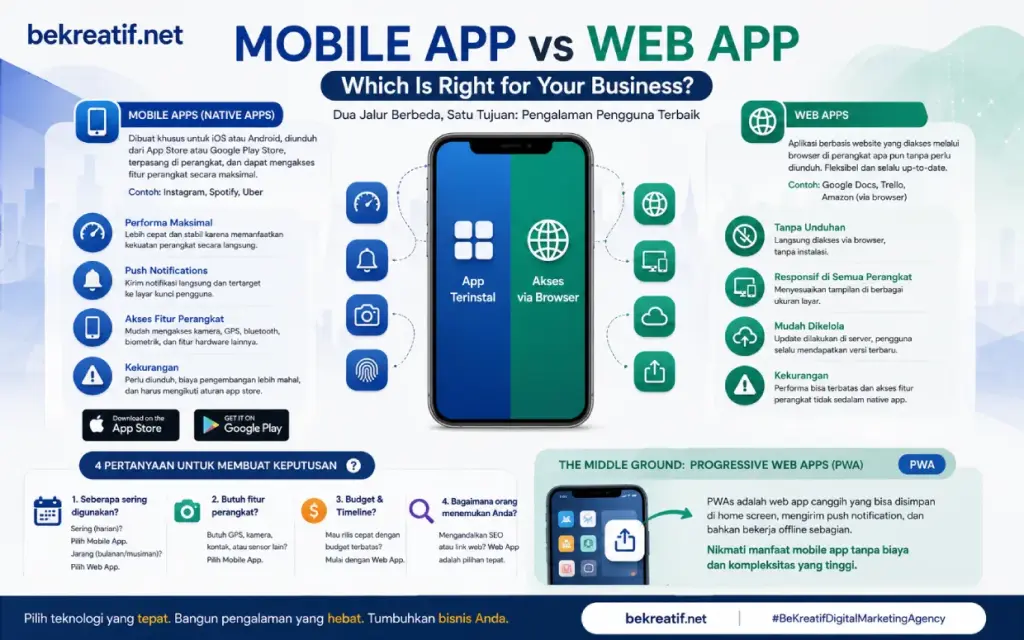
Before diving into the strategy, let's clear up the technical jargon. Mobile app vs web app, Which Is Right for Your Business, they might look similar on a smartphone screen, but under the hood, they are entirely different beasts.
Mobile Apps (Native Apps)
A mobile app is built specifically for a mobile operating system (like iOS or Android). Users download it directly from the Apple App Store or Google Play Store. It lives on the device, takes up storage space, and can tap into the phone’s hardware (like the camera, GPS, and push notifications) with ease.
Examples: Instagram, Spotify, Uber.Web Apps

A web app is essentially a highly interactive website optimized for mobile viewing. It doesn't require downloading from an app store; users simply access it via a mobile browser (like Safari or Chrome). It adapts to whatever screen size the user has, behaving like an app without taking up internal device storage.
Examples: Google Docs, Trello, Amazon (accessed via browser).
When to Choose a Web App
The Golden Rule: Choose a mobile app if your business model relies on high user loyalty, frequent daily engagement, or deep integration with phone hardware.
The Advantages:
Unmatched Performance: Native apps are faster and more reliable because they leverage the device’s processing power directly.
Push Notifications: This is the holy grail of customer retention. Mobile apps allow you to send direct, targeted reminders straight to the user's lock screen.
Hardware Access: If your product requires the camera (for AR filters), Bluetooth (for IoT devices), or advanced biometric login (FaceID), a mobile app handles this seamlessly.
The Drawbacks:
The Download Friction: Let’s be honest—nobody wants to download an app just to buy a single pair of socks. Getting a user to download an app requires significant trust and incentive.
High Upkeep: You have to maintain two separate codebases (iOS and Android) and deal with app store gatekeepers who take a cut of in-app purchases.
The Decision Framework: Ask Yourself These 4 Questions
If you are still on the fence, run your business idea through this quick diagnostic framework:
How often will customers use this? If it’s multiple times a day (like a fitness tracker or messaging tool), build a Mobile App. If it’s once a month or seasonal (like a tax calculator or event registration), build a Web App.
Do I need native phone features? If your app absolutely requires background GPS tracking, the camera, or contact lists to function properly, go with a Mobile App.
What is my budget and timeline? If you need to launch a Minimum Viable Product (MVP) in 6 weeks on a tight budget, start with a Web App. You can always build a mobile app later once you prove the concept.
How will people find me? If you already have a strong SEO presence or intend to drive traffic via web links, a Web App captures that audience instantly.
The Middle Ground: Progressive Web Apps (PWAs)
If you're torn down the middle, consider a Progressive Web App (PWA). PWAs are advanced web apps that can be saved to a user's home screen, send basic push notifications, and even work partially offline. They offer a middle-tier compromise, giving you some mobile app perks without the steep app store development costs.